




































Customer Relationship Management (CRM) integrates all business processes, communication channels, and company departments that have direct contact with customers. These primarily include the marketing, sales, and service departments. Customer contact is the top priority throughout the entire duration of the relationship, because the value of existing customers increases continuously as the relationship grows.
However, individual companies’ definitions of Customer Relationship Management always differ slightly from one another, depending on their respective business concepts: Because Customer Relationship Management (CRM) is not an isolated tool and must be integrated into processes as part of the company’s philosophy, the company’s specific structure also helps determine its own definition.
To explain: Customer Relationship Management (CRM) emerged from a clear need. In the pre-digital era, a company’s products and services took center stage, and buyers were sought out and found through advertising. That has changed. Today, companies focus on their customers and their product preferences, provide a tailored offering that includes expert advice, and ensure that customers can trust the company in order to build long-term loyalty. This shift from a product-centric to a customer-centric approach demonstrates that Customer Relationship Management is crucial for sustainable business growth—from acquiring new customers to re-engaging former customers throughout the entire customer lifecycle.
Table of contents
Part of the CRM definition: CRM Goals
The following 7 objectives are the most important:
- Lasting customer relationships:
The goal of a customer relationship is long-term customer loyalty to the company. This primarily serves to increase profits, secure market share and thus the growth of the company, e.g. by customers recommending the company to colleagues, friends and acquaintances through their satisfaction and making repeat or follow-up purchases. - Individual customer relationship:
Differentiating customer relationships in terms of products or services, which are recommended in individual consultations, promotes customer loyalty to the company. - Customer orientation:
A targeted orientation of all company activities towards the needs and wishes of potential and existing customers in the sense of comprehensive processing is elementary. - Focus on profitability:
The focus should always be on those customers who are particularly profitable for the company. However, this does not mean that less profitable customers should be treated less favorably. - Systematization:
Systematic customer processing, which is geared towards the customer's needs and extends across the customer relationship cycle, is of great importance. - Increasing efficiency:
By simplifying administrative work, optimizing processes, integrating and analyzing data, a company can increase its efficiency according to the CRM definition. - Optimized processesthrough CRM software:
The more customers a company has, the more difficult it becomes to know the individual needs of each customer. This also makes it more difficult to make them individual offers and provide them with needs-based support. The acquisition of CRM software helps to optimize the customer relationship according to the CRM definition. Customer data can be called up in the software at any time via integrated databases. This means that processing procedures or customer meetings can be customized. In addition, resources are used more efficiently and wastage is avoided.
CRM Strategies
Also part of the definition of Customer Relationship Management (CRM)
With the CRM strategy, the company management and the internal CRM team develop the guidelines and objectives based on customer and market requirements.

Examples of possible strategies include:
- Identifying and leveraging market
- opportunities (revenue/costs)
- Early identification of customer needs
- Improving service quality
- Implementing a key account strategy
- Increasing customer satisfaction
- Improving internal processes
- Increasing revenue
- Improving employee satisfaction
New CRM definition: Empathic CRM
In addition to the four familiar forms of CRM, a new form of CRM definition has emerged in the last two years: Empathic CRM. As a person-centered approach to unrestricted customer management, it is playing an increasingly important role. Individual decision-making and action motives are the basis for the development of new or existing customers. The aim of empathic CRM is to take into account all touchpoints between the company and the customer (customer journey) as well as all relevant information about the customer and make it usable for the development of a sustainable customer relationship.
Additions to the CRM definition
Retention marketing
Retention marketing is a strategic marketing approach with the aim of increasing customer loyalty. For this purpose, important customer groups are segmented in the company in order to bind them to the company in the long term with targeted measures (example: payback cards).
To this end, data from the CRM software and systematic market research is collated and evaluated as the basis for database marketing. Subsequent activities are designed to increase customer value, extend the customer life cycle and thus increase revenue per customer for the company.
Social CRM
Social CRM is a relatively new trend that extends operational CRM. The main focus is on potential and existing customers, who are more strategically involved in a collaborative dialog via the Internet and social media platforms (such as Facebook, WhatsApp, Twitter or Instagram). The aim is to find out what customers want, but also to disseminate quick responses and reactions to customer satisfaction.
Mobile CRM
Mobile CRM enables the sales force to access customer data from anywhere. To this end, modern technologies are used that enable work via the browser (CRM in the cloud) or in a native CRM app.allow. As the availability of mobile data cannot yet be guaranteed across the board, mobile CRM is viewed critically in some companies. However, there are already CRM apps that are offline-capable.
Elementary for CRM
The right system, CRM analysis and the use of the insights gained
CRM systems are tools for optimizing customer relationship management. They improve this according to one of the CRM definitions mentioned above by recording customer data and processes that are relevant to the company's success.
The CRM software supports all areas of the company that are in contact with customers. CRM is used particularly frequently in sales, but also in marketing or for service & IT. To decide which program best suits your company, get a CRM software function overview in advance.
The introduction of a CRM system offers great potential for intensifying existing or developing business relationships. However, the prerequisite for this is, on the one hand, the analysis of buying and decision-making motives and, on the other hand, the use of these findings in customer care and acquisition for individual communication through adapted strategies, processes and technical solutions on the part of the company.
Data is collected and analyzed on an ongoing basis and produces data for the evaluation and consideration of future developments. This data and the associated decisions in turn form the basis for further analyses and new decisions.
CRM analysis covers the following areas:
- Customer segmentation(for example, subdividing customers according to purchase probability)
- Profitability analysis(which customers have the greatest potential?)
- Personalization(targeted approach to customers based on existing data)
- Purchase probability(analysis to place targeted offers based on purchases made (cross-selling and up-selling))
- Prediction models(analysis of customer questions and complaints to identify products that promise success)
Avoid typical mistakes when implementing your CRM!
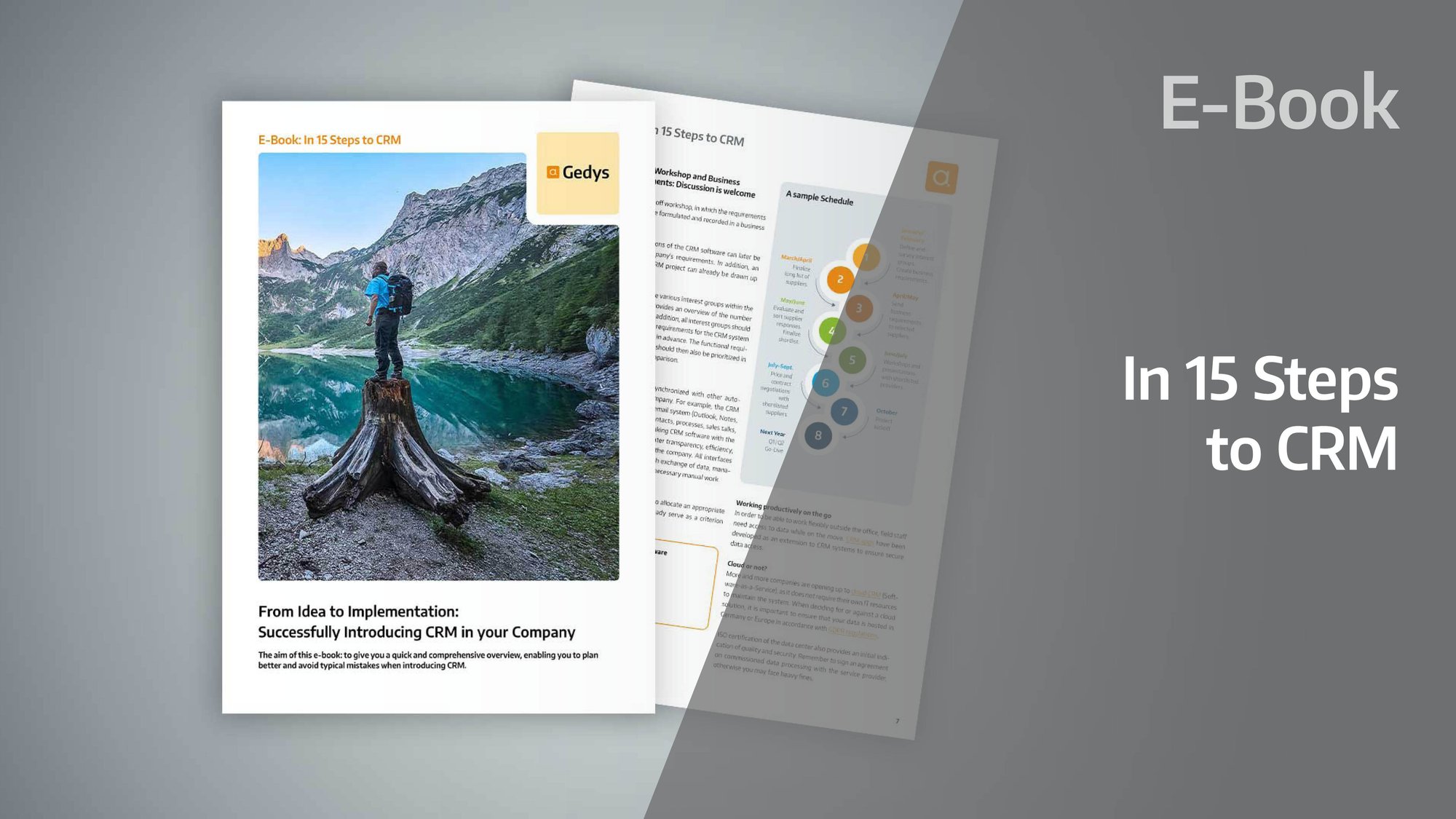
Free E-Book
Learn what really matters when implementing a CRM. With our free e-book, you’ll quickly get a comprehensive overview, be able to plan more effectively, and avoid typical mistakes during CRM implementation!